Nehemiah 3:16 — Leading by Doing
After him Nehemiah the son of Azbuk, official of half the district of Beth-zur, made repairs as far as a point opposite the tombs of David, and as far as the artificial pool and the house of the mighty men.
 The Book of Nehemiah tells us of a man who was an excellent leader very much like an orchestra conductor. Nehemiah was deeply committed and involved in the work and issues at stake. He even knew how to develop other leaders. For this reason, religious books on the topic of leadership often go to Nehemiah. We see in our text one of the men whom Nehemiah developed as a leader. This man held a position of prominence, and he was personally involved in the work. The man’s name was Nehemiah, but he was not the Nehemiah who led the rebuilding of Jerusalem’s walls. Nehemiah was working for a cause much greater than himself. We learn one valuable lesson from the second and lesser Nehemiah. Leadership means involvement in the work. Read the rest of this entry
2 Chronicles 3:16 — Jachin and Boaz
He made chains in the inner sanctuary and placed them on the tops of the pillars; and he made one hundred pomegranates and placed them on the chains.
 As we study Old Testament history, we see pillars play significant roles. Jacob and Laban used pillars as a promise to God that neither man would trust the other. A pillar of fire led the Israelites through the wilderness. The church is called the pillar and ground of the truth1. God honors Christians as pillars in the temple of God in heaven2. When we read our text, we find that two pillars play a prominent part in worship in Solomon’s Temple. These two pillars were known by name as Jachin and Boaz. We will learn that the message of Jachin and Boaz is simple. We must trust God establish our service for the Lord in His strength. Read the rest of this entry
1 Chronicles 3:16 — Endless Genealogies
The sons of Jehoiakim were Jeconiah his son, Zedekiah his son.
 Our text takes us to a genealogy which lists the end of a dynasty. Our text tells us of the last kings in the line of David. What does our text mean for us today? Why should we even care about the lists of names? The genealogies of the Bible are important to today’s Christians. We learn from the genealogies that God is concerned about fulfilling His promises, your family, and your worship. Read the rest of this entry
2 Kings 3:16 — Dig Your Ditches BEFORE the Water Comes
He said, “Thus says the LORD, ‘Make this valley full of trenches.’
 The people in our text badly needed something to defeat an enemy. They desperately needed water in order to survive. The area where they were was not suitable to receive the water they so desperately needed. They went to a prophet to get advice, and the prophet told them to dig ditches. Digging ditches was not a likely method to defeat an enemy, let alone to find water, but the Lord commanded that ditches be dug. The lesson we will learn from our text is when we obey God, we may expect God’s blessings. Read the rest of this entry
1 Kings 3:16 — Common Sense
Then two women who were harlots came to the king and stood before him.
 What is common sense? Common sense is basically practical reasoning. It is the ability to see things as they really are and doing something reasonable about those things. We could substitute the idea of common sense with the word wisdom. Wisdom is the ability to take what you know of something and apply it to your actions. A person who is good at working with wood can be considered wise in the area of woodworking. A person who is great with mechanical things would be considered wise in the area of mechanics. Each person takes what he knows of his trade and applies it to his work. When we think of wisdom in the spiritual sense, wisdom is taking what we know of God and applying it to our lives. Read the rest of this entry
2 Samuel 3:16 — Weeping All the Way to Bahurim
But her husband went with her, weeping as he went, and followed her as far as Bahurim. Then Abner said to him, “Go, return.” So he returned.

We have all been placed in no win situations. We have all been asked to do things or have been given responsibilities, and we had no choice because someone manipulated us and the situation. We felt like puppets. 2 Samuel 3 tells us an interesting story about people who placed an innocent victim in the middle of circumstances beyond her control. Michal became a pawn to broker a political deal. The people around Michal used and manipulated her to gain advantage for themselves. We have all been manipulated at one time or another, and we have either manipulated someone else or we have at least been tempted to manipulate a circumstance for our advantage. Manipulation is always purely self-centered, having no place in a believer’s life. The believer is called to serve others as he would serve himself, and manipulation has no place in the second half of the great commandment. The lesson we learn from our text is very simple. Do not use people to gain personal advantage. Read the rest of this entry
1 Samuel 3:16 — Listening to God’s Voice
Then Eli called Samuel and said, “Samuel, my son.” And he said, “Here I am.”
 We as human beings have a problem with our hearing. In other words, we hear what we want to hear. Wives often think that their husbands have selective hearing. The husband hears only certain things his wife says. Children also have selective hearing. They can hear you silently scoop ice cream, but they cannot hear you tell them to do their chores. Read the rest of this entry
Ruth 3:16 — Who Are You?
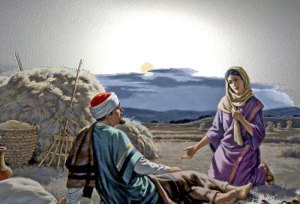 And when she came to her mother in law, she said, Who art thou, my daughter? And she told her all that the man had done to her.
The Book of Ruth portrays a lovely picture of our salvation. Ruth, a Moabite, moved to Israel with her mother-in-law Naomi. Jewish society did not permit women to possess land, so the land of her late husband’s estate was in legal limbo. Ruth had no money and no job. Being a foreigner, Ruth had no rights nor standing in society. In a love story unmatched by human literature, a man named Boaz placed Ruth into Read the rest of this entry
Judges 3:16 — God’s Left-Handed Right-Hand Man
 Ehud made himself a sword which had two edges, a cubit in length, and he bound it on his right thigh under his cloak.
In Judges 3 we find a man who was a left-hander or a south-paw. By all intents and purposes, he was at a disadvantage in his culture. We learn a valuable lesson from this lefty in the Bible. God can use anything to accomplish His purposes, including our weaknesses and handicaps. 1 Corinthians 1:27 says, “but God has chosen the foolish things of the world to shame the wise, and God has chosen the weak things of the world to shame the things which are strong,”. God can use you despite your weaknesses. Read the rest of this entry

 3.16's of the Bible